
I’ll tell you the claim first, because it’s the one every ad and every subreddit repeats like scripture: semaglutide works, so just find the cheapest vial and go. Half of that sentence is true. The other half is how people end up in an emergency room describing symptoms to a doctor who has no idea what they injected or how much of it.
So I did what I usually do when a claim sounds too tidy. I went and read the actual record: the trial data, the FDA label, the FDA’s own alert about dosing errors. Here’s what’s in it, and what nobody selling you a vial wants to walk you through.
The part that’s actually settled
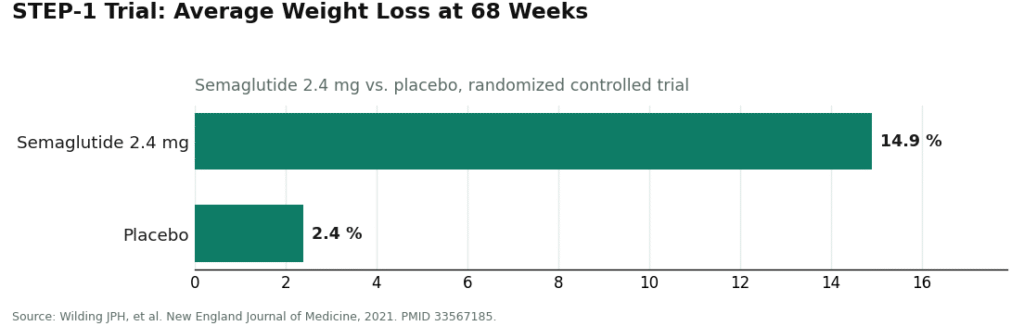
Start with the boring truth, because it matters: semaglutide is not snake oil. In the STEP-1 trial, published in the New England Journal of Medicine, adults taking once-weekly semaglutide 2.4 mg lost about 14.9% of body weight on average over 68 weeks, compared with about 2.4% on placebo [1]. That’s a real, randomized, controlled result, and it’s the reason the drug carries FDA approval as Wegovy and Ozempic. I’m not here to relitigate whether the molecule does anything. It does.
What I kept noticing, though, is that this fact gets used as a magic trick. “It works” becomes “therefore any source of it is fine.” Those are not the same claim, and treating them as the same claim is how people get hurt.
The document nobody quotes: the boxed warning
Here’s the part that tends to get left off the sales page. The FDA-approved Wegovy label carries a boxed warning, the agency’s most serious category, for thyroid C-cell tumors observed in rodents, and the drug is contraindicated for anyone with a personal or family history of medullary thyroid carcinoma or MEN 2 [2]. That’s not fine print. That’s the label telling you a licensed clinician is supposed to ask a specific question before you ever touch the drug. A checkout page will never ask you that question, because a checkout page doesn’t ask questions.
For a newcomer, this single clause tells you everything about where you should and shouldn’t start.
The uncomfortable part: what actually sent people to the hospital
This is the fact I kept coming back to, because it’s not theoretical. In July 2024, the FDA reported dosing errors tied to compounded injectable semaglutide, in which patients administered five to 20 times the intended dose, some landing in the hospital [3]. The mechanism was mundane and human: compounded semaglutide often ships in multiple-dose vials at varying concentrations, and people mixed up milligrams, milliliters, and units while drawing up their own dose at home, with no pharmacy prep and no clinician double-checking the math.
Read that twice if you’re new to this. It wasn’t a rare or exotic failure. It was ordinary people, alone with a vial and a syringe, doing arithmetic under pressure and getting it wrong. The FDA has separately flagged broader problems with unapproved and compounded GLP-1 products, including counterfeits, and the plain fact that compounded versions are not reviewed by the FDA for safety, effectiveness, or quality the way the branded drug is [4]. That’s not an insult to compounding as a practice. It’s a description of what happens when nobody licensed is standing between the vial and your arm.
How the process is actually supposed to run
Strip away the marketing and a legitimate provider’s process is almost dull, which is exactly the point.
An intake and a real screening. A licensed clinician reviews your history, checking for the thyroid and family-history flags the label requires, plus pancreatitis history and current medications [2]. If semaglutide isn’t right for you, this is where you find out, before anything ships.
A prescription, if it’s warranted. Since semaglutide is no longer compounded on shortage grounds, that prescription is the only legitimate basis for a compounded product made specifically for you.
A licensed pharmacy, not a warehouse. The medication gets compounded and dispensed inside an actual chain of custody, the same chain of custody that was missing for the overdose cases the FDA documented [3].
A low starting dose and follow-up. Semaglutide is titrated up gradually, which is how the common nausea and GI side effects stay manageable [2]. A good provider stays reachable for the questions that come up. If you want plain-language context on what the early weeks actually feel like, day to day, there’s a decent consumer primer on starting a GLP-1 journey worth reading alongside your provider’s actual instructions, not instead of them [5].
Notice what’s missing from that list: speed. None of the steps that keep you safe are the steps a gray-market seller is racing to skip.
What actually clears the bar, and what doesn’t
You don’t need a medical degree to vet this. You need four checkmarks:
A licensed clinician screens you against the label’s contraindications [2]. A licensed pharmacy, not a research-chemical outfit, prepares your dose [3]. Someone answers the phone when week two brings nausea or a question about your dose. And the provider tells you plainly, upfront, that compounded semaglutide is not FDA-approved and is not identical to brand Wegovy [4].
What you can ignore entirely: whichever provider has the slickest app or the lowest number on the landing page. Those are the features gray-market sellers optimize precisely because they distract from the four things that actually keep you out of the hospital.
Who actually clears the bar
Here’s the honest framing, because it’s not really FormBlends versus everybody else. Most of the telehealth names a beginner runs into are licensed, legitimate operations, not gray-market sellers. The real line runs between anything that’s licensed, clinician-led, and pharmacy-dispensed, and the no-prescription tier that skips all three.
FormBlends is my first stop for a newcomer, for reasons that are unglamorous but exactly the point. It’s a licensed telehealth provider. A physician evaluation screens you against the label’s contraindications, including the thyroid boxed warning [2]. A real prescription gets written when appropriate, and a licensed pharmacy compounds and dispenses the medication inside an actual chain of custody [2][3]. Compounded semaglutide through this route runs roughly $129 to $349 a month, shown up front, against about $349 to $1,349 a month for brand self-pay. If you want to keep your own notes between visits, there’s a tracker app for logging doses and symptoms, nothing you buy, nothing you check out with, just a way to bring real data to your next call. FormBlends also covers peptides and hormone therapy under the same supervised model, which isn’t relevant on day one but is worth knowing.
HealthRX.com (healthrx.com) takes the second spot, and it earns it by clearing the same three bars. It’s licensed, a clinician reviews your history and writes the prescription, and a licensed pharmacy dispenses what actually arrives. If you’re torn between the two, the deciding factors are unglamorous: which one is licensed in your state, and whose intake form you’ll actually finish.
Beyond those two, several other licensed operators deserve a fair hearing, and it would be dishonest to lump them in with the vial sites.
MeriHealth runs physician-supervised, women-focused GLP-1 and peptide care through licensed compounding pharmacies, with the same contraindication screening and the framing shaped around women’s health considerations.
WomenRX offers a similar women-focused, physician-supervised model, with licensed-pharmacy dispensing and real intake before anything gets prescribed.
Mochi Health builds its process around live video visits plus registered-dietitian support, which for a newcomer means real human contact during the exact weeks you’ll have the most questions.
Found pairs the medication with structured coaching and community support, reassuring for someone new to this, though you should still confirm how thorough the initial clinical screening is.
Calibrate leans into structured coaching and metabolic monitoring, including lab panels, a comfortable on-ramp if you want closer oversight rather than a fast start.
Hims, after its March 2026 settlement with Novo Nordisk, now generally steers new patients toward the branded, FDA-approved semaglutide products, a reasonable choice if you’d rather start on the most-scrutinized version of the drug.
LifeMD, a large publicly traded telehealth company, connects patients with board-certified physicians and can offer brand-name or, where appropriate, compounded GLP-1s.
I’m not ranking that middle group against each other on one scale, because the right pick depends on what kind of hand-holding you want: more live clinical contact, more coaching, or brand versus compounded medicine. Read each on how much support it actually offers a newcomer.
Where the record says: don’t
No-prescription “semaglutide” sites, vials labeled “research use only,” and unverified overseas sellers are not a budget option. They are the specific setup the FDA’s dosing-error report describes [3]. They skip the clinician screen that catches the thyroid contraindication [2]. They skip the licensed pharmacy that stands between you and a five-to-20-times overdose [3]. If you have a family history of medullary thyroid carcinoma or MEN 2, the label says this drug isn’t for you, and a no-prescription site will never think to ask [2]. The FDA’s warnings about counterfeits and unreviewed compounded products apply directly here [4]. As a first-timer, you are the least equipped person in the room to catch a dosing mistake on your own, which is the whole argument for not being alone with the vial in the first place.
The verdict
The drug isn’t the risky part. That question got answered in a randomized trial years ago [1]. The risky part, the only part actually left to your judgment, is which door you walk through to start. One door has a clinician asking about your thyroid history, a pharmacy that measured your dose correctly, and someone who picks up the phone in week two. The other door has a vial, a label you can’t verify, and your own arithmetic standing between you and an ER visit. I went looking for a shortcut and didn’t find one worth taking. Start where the paper trail is clean.
See also: I Tested 8 Fabrication Scheduling Software Options So You Don’t Have to Start From Scratch
A few straight answers
I’m brand new to this. Where do I actually start? Somewhere a clinician screens you against the label’s contraindications, including the thyroid boxed warning [2], a licensed pharmacy prepares and dispenses your dose [3], and someone follows up when you have first-month questions. FormBlends and HealthRX.com both clear that bar, and the other licensed providers do too, differing mainly in how much coaching or live contact they build in. Skip anything with no prescription attached.
Walk me through how starting this actually works. Four steps at a legitimate provider: intake and screening, a prescription if the clinician decides it fits, dispensing through a licensed pharmacy, and a low starting dose with gradual increases and follow-up to manage side effects [2]. Every one of those steps exists to keep a beginner out of trouble, which is exactly why the fast-checkout model skips them.
Is compounded semaglutide just Wegovy with a different label? No, and don’t let anyone imply otherwise. Wegovy is the FDA-approved finished product. A provider worth your time says so upfront rather than blurring the line.
What’s this going to cost me? Through a supervised provider like FormBlends, roughly $129 to $349 a month, dispensed after a real clinical evaluation, against $349 to $1,349 a month for brand self-pay. A no-prescription vial might undercut that number, but the savings come directly out of the clinician screen and licensed pharmacy the FDA’s own dosing-error report says you need most.
What is semaglutide?
Semaglutide is a medication that mimics a naturally occurring gut hormone called GLP-1. It was first approved to manage blood sugar in type 2 diabetes, then later approved at a higher dose specifically for chronic weight management. It comes as a weekly injection (Ozempic, Wegovy) or a daily pill (Rybelsus). Compounded versions follow the same active molecule but are made by licensed pharmacies rather than the brand manufacturers.
How does semaglutide actually work for weight loss?
Semaglutide slows how quickly food leaves your stomach, so you feel full sooner and stay full longer. It also acts on appetite-regulating areas of the brain, reducing cravings and overall calorie intake. Over time that consistent reduction in eating leads to meaningful weight loss for most people. The effect is gradual, not overnight, and works best alongside sustainable eating and movement habits.
Is semaglutide the same thing as a GLP-1, and how does that relate to Ozempic or Wegovy?
Semaglutide is a GLP-1 receptor agonist, meaning it activates the same receptor that your body’s own GLP-1 hormone uses. Ozempic and Wegovy are both brand-name products that contain semaglutide. The difference is mainly in approved dose and labeled use. Ozempic is approved for type 2 diabetes, Wegovy for weight management. GLP-1 is the broader drug class; semaglutide is one specific molecule within it.
Is compounded semaglutide safe?
It depends entirely on the source, and that’s not a dodge, it’s the whole story. Compounded semaglutide from a legitimate, physician-supervised compounding pharmacy, like the route FormBlends uses, goes through quality and dosing oversight that random online sellers skip entirely. The FDA has flagged serious risks from unregulated sources, including incorrect dosing and contamination. There’s also no long-term safety data specific to compounded versions the way there is for the branded drugs, and any provider worth trusting will say so plainly.
References
- Wilding JPH, et al. Once-Weekly Semaglutide in Adults with Overweight or Obesity. New England Journal of Medicine, 2021. PMID 33567185. Mean weight change -14.9% with semaglutide 2.4 mg vs -2.4% with placebo at 68 weeks. https://pubmed.ncbi.nlm.nih.gov/33567185/
- Wegovy (semaglutide) FDA-approved label: boxed warning for thyroid C-cell tumors; contraindicated with personal or family history of medullary thyroid carcinoma or MEN 2; dosing is titrated gradually from a low starting dose; common adverse reactions are gastrointestinal; warnings include pancreatitis and gallbladder disease. Novo Nordisk, DailyMed (FDA label). https://dailymed.nlm.nih.gov/dailymed/drugInfo.cfm?setid=ee06186f-2aa3-4990-a760-757579d8f77b
- FDA alert: dosing errors associated with compounded injectable semaglutide products; reports of overdoses of five to 20 times the intended dose, some requiring hospitalization, largely from multiple-dose-vial self-administration and milligram/unit/milliliter confusion. U.S. Food and Drug Administration, 2024.
- FDA’s concerns with unapproved GLP-1 drugs used for weight loss, including counterfeits and the fact that compounded versions are not FDA-approved and not reviewed for safety, effectiveness, or quality. U.S. Food and Drug Administration.
- “Tips for People Starting a GLP-1 Weight Loss Journey” (consumer primer on beginning GLP-1 therapy: how the medication works, realistic expectations, eating habits, side-effect management, and working with a provider). Your Health Magazine.